Visual Math for Kids: Learn While Playing
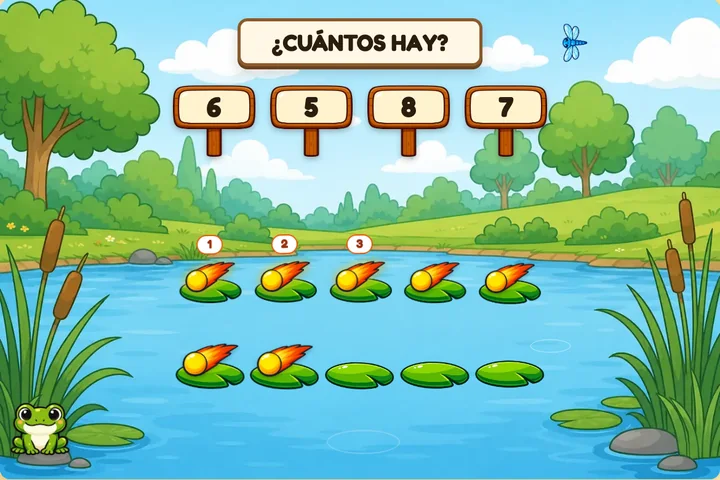
Count the objects and pick the right answer.
Visual math is the natural way to learn math at this age. Instead of abstract numbers, kids count apples, cars or stars and discover the concepts of quantity, addition and subtraction intuitively. Every problem arrives on a train: the objects ride in the wagons in rows of five, and the answer is picked by tapping one of the station signs.
Three game modes: Easy Add with results up to 5 (4-5 years), Medium Add up to 10 (5-6 years) and Subtract up to 10 (5-6 years). Every problem arrives on a train: in additions, each number rides in its own wagon with the objects in rows of five; in subtractions, the ones being taken away jump off the wagon. After a right answer, a voice counts the objects one by one. The objects change with every problem: fruits, animals, toys, space and sweets.
What do kids learn with visual math?
- Number and quantity concepts by counting objects, from 1 to 10
- Basic addition and subtraction with results up to 5 or up to 10 (ages 4 to 6)
- Visual pattern recognition across 5 themes: fruits, animals, toys, space and sweets
- Concentration and reasoning in short sessions designed for a young child's attention span
- Out-loud counting with supporting narration for those who can't read yet (ages 3 to 5)
After a right answer, the wagons couple together and a voice counts the objects one by one as each number appears. At the end of the ten problems you can see how many were right on the first try. All free, no downloads.
Frequently asked questions
Does the child need to read to play the math game?
No. The game is designed for kids ages 4 to 6 who can’t read yet: each problem is shown with objects in the wagons of a train, a voice reads the question at the start, and the answers are big numbers on signs that only need to be recognized and tapped. After a right answer, the voice counts the objects out loud, so the child links the amount they see with the number and its name.
Does the math game have audio?
Yes. A voice recorded in the site’s 4 languages (English, Spanish, Portuguese and French) reads the question at the start and, every time the child gets it right, counts the objects one by one. The train arrives and leaves with a whistle, and right and wrong answers have their own sounds. Everything can be turned off with the sound button at the top.
What happens after a wrong answer?
The chosen sign wiggles and the child can try again: the train waits. The answers offered are numbers close to the result, so kids have to count instead of guessing. At the end of the ten problems you can see how many were right on the first try.
Train whistle: C57 180 locomotive, recorded by SL Story’s on Wikimedia Commons (CC BY-SA 4.0).
Visual Addition & Subtraction is one of the 6 math games on Amigoki.